


The contract is signed. The champagne's poured. And that's exactly where most customer relationships start quietly falling apart.
Every sales team has a moment they celebrate: the deal closes, the confetti in Slack goes off, the AE moves on to the next opportunity. It is treated as the finish line. In reality, it is closer to a relay race — and the handoff is where most teams drop the baton.
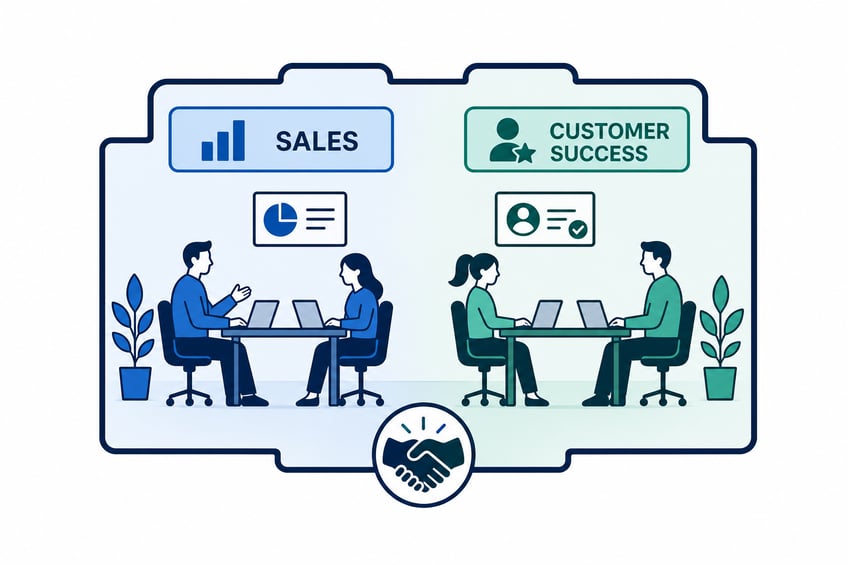
The handoff between sales and customer success is not an administrative footnote. It is one of the highest-leverage, lowest-visibility moments in the entire customer lifecycle — and for a lot of companies, it is where the customer relationship quietly starts to sour, long before anyone notices a problem.
But here is what most companies miss entirely: the problem does not start at the handoff. It starts at the RFP.
Let’s take a look at just some of the ways ClientPoint humanizes your digital selling environment and wins you and your team more deals. If you'd like to learn more about how ClientPoint can help you communicate to your clients and team, click here to book a demo with one of our experts.

The average RFP win rate across all industries is 45%, meaning more than half of all proposals still lose. That statistic is striking on its own. But the more important question is not just why those proposals lose. It is when the losing actually begins.
For most organizations, the answer is uncomfortable: deals are often lost before the first follow up call, before the negotiation, and sometimes before the proposal has even been read. They are lost in the gap between what was promised in the RFP response and what the delivery team was ever actually prepared to deliver.
The average time to draft and submit an RFP response is 25 hours, down 17% from the prior year, and 68% of proposal teams now use AI to help them get there faster. Speed and quality are improving. But the intelligence captured during that 25 hour process, the buyer's specific pain points, decision criteria, stakeholder priorities, and success metrics, rarely makes it past the proposal document itself.
It sits in a folder. Or in someone's inbox. Or nowhere at all.
RFPs drive an average of 39% of total revenue, approximately $256 million annually per organization, which puts win rate squarely at the center of revenue planning. When the context from those proposals does not transfer to the teams responsible for delivery and retention, organizations are not just losing deals. They are losing the compounding value of every deal they do win.
Top performing teams, those with win rates of 60% or higher, submit approximately 81% of their bids only after a formal go/no-go decision, and use pre-approved content libraries to maintain consistency and speed. What separates these teams is not just better writing. It is better systems for capturing, organizing, and transferring the intelligence that lives inside every proposal.
Teams that reuse 66% of content across proposals and complete responses in under 10 calendar days are outperforming teams that start from scratch every time, not because their proposals are more generic, but because their foundational content is better organized and their personalization is more focused.
The organizations winning at the RFP stage and retaining those clients afterward share one thing in common: the proposal is not treated as a standalone document. It is treated as the first chapter of a relationship, and every detail in it is carried forward into onboarding, delivery, and renewal.
The average RFP win rate is 45%, based on Loopio's 2025 RFP Response Trends and Benchmarks Report, the most comprehensive annual study of the RFP response profession, drawing on data from over 1,500 global teams. Top performing teams report win rates of 60% or higher, while the lowest 16% of teams win fewer than 20% of the bids they submit.
That gap between the top performers and the bottom is not a talent gap. It is a process gap. And the process breakdown almost always traces back to two connected failures: proposals that do not capture enough specific intelligence about the buyer, and handoffs that do not transfer the intelligence that was captured.
Teams using dedicated proposal software report 22% higher satisfaction with their win rate, 24% higher satisfaction with their ability to respond to RFPs, and 61% achieve ROI within the first year of implementation.
The math is clear. The question is what to do about it.
 If you'd like to learn more about how ClientPoint can help you manage your clients and team, click here to book a demo with one of our experts.
Think about what actually happens the instant a deal closes. The salesperson who spent weeks or months understanding the customer's problem, building trust, and tailoring a pitch to their specific situation, disappears. In their place: a new team, often meeting the customer for the first time, asking them to re-explain everything they just spent an entire sales cycle explaining.
From the customer's side, this is jarring. They did not buy from "a company", they bought from a person who understood their problem. When that person vanishes and is replaced by someone asking "so, what are you hoping to achieve here?" confidence in the purchase starts to wobble before onboarding has even really begun.
This is why the sales to customer success handoff deserves to be treated as a revenue-critical transition, not a scheduling formality. It directly shapes how quickly a customer sees value, whether their expectations match reality, and whether they walk away seeing your company as a long-term partner or just another vendor. (Rocketlane, 2026)
| Sales is like the ground crew that gets you on the plane. Customer success is the crew that has to deliver the flight. If they've never spoken to each other, the passenger notices. |
4. The Math Behind a "Small" Handoff Problem
If you'd like to learn more about how ClientPoint can improve your meeting setup, click here to claim a free demo with one of our experts.
Handoff friction doesn't feel dramatic in the moment. A missing note here, a vague CRM field there. But churn caused by early disengagement compounds in a way that's easy to underestimate.
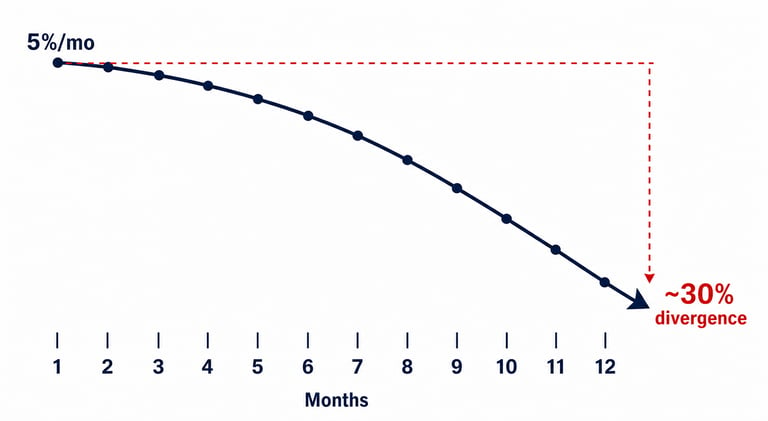
Consider the math: if you lose just 5% of paying subscribers every month, that works out to nearly a 50% annual churn rate and after just one year, roughly a 30% divergence between your customer count and your revenue (Avoma, 2025). A weak handoff doesn't need to cause every cancellation to be expensive. It just needs to nudge the early-tenure churn rate up a few points, and the compounding effect on annual recurring revenue is significant.
The reverse is just as measurable. Organizations with strong cross departmental alignment between sales and CS see 20–30% higher upsell and cross-sell revenue, and customers who move through a clear, well-structured onboarding journey show meaningfully lower churn and higher lifetime value (Prezentor, 2026). The handoff isn't a soft, feel-good metric it shows up directly in net revenue retention.
5. Why the Handoff Breaks: A Story of Misaligned Incentives
 If you want to see exactly how ClientPoint fits into your workflow, one of our experts can walk you through it — click here to claim a free demo.
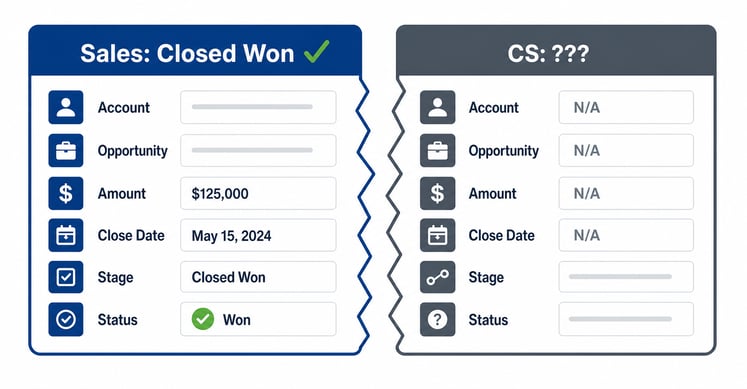
The structural problem is almost embarrassingly simple once you name it: sales and customer success are optimizing for two different things. Sales is measured on closed revenue. CS is measured on retention, satisfaction, and expansion. The handoff sits exactly on the fault line between those two incentive systems and that fault line is where things fall through (The Marketing Juice, 2026).
Account executives are typically compensated on closed deals, not on the quality of what they leave behind for the team taking over. The moment a contract is signed, an AE's attention quite rationally, given how they're paid shifts to the next opportunity in the pipeline. Writing a thorough handoff brief starts to feel like homework assigned after graduation (Sybill, 2026). The result: CRM fields that should capture the buyer's real pain points, success criteria, and internal stakeholder dynamics are left empty, filled with shorthand only the AE understood, or copy-pasted from a generic template that says nothing specific about this customer at all (Rocketlane, 2026).
None of this makes AEs the villain. It's a predictable outcome of measuring one half of the relay team on speed and the other half on distance, and never checking whether the baton actually made it between them.
6. The Telephone Game Nobody Signed Up For
See how ClientPoint helps you communicate value, not just send quotes — book a demo.
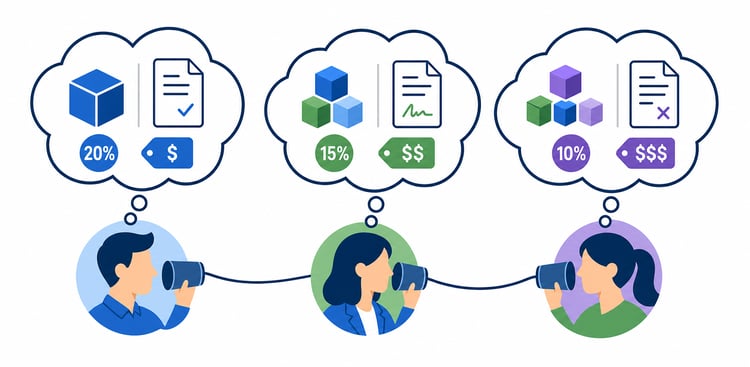
Without a structured handoff, what fills the gap is reconstruction and reconstruction is where the telephone game begins. What the customer believes they bought, what the sales team believes they sold, and what the delivery or success team believes they're responsible for can end up as three subtly different stories (The Marketing Juice, 2026).
When CS teams inherit a blank or thin CRM record, they're forced to spend hours reconstructing deal context from scratch, or worse asking the customer to repeat goals they already explained during the sales process. Either way, it signals something the customer wasn't supposed to notice: that the team now responsible for their success isn't actually prepared to deliver on what was sold (AskElephant, 2026). One documented benchmark found this reconstruction work alone can eat up 5 to 10 hours of onboarding prep per account when handoff data is incomplete (AskElephant, 2026).
This is the moment where churn risk quietly takes root not because the product underperformed, but because the experience after signing felt disconnected from the experience before it (Sybill, 2026).
If you're ready to see it in action, claim a free demo here and we'll walk you through it.
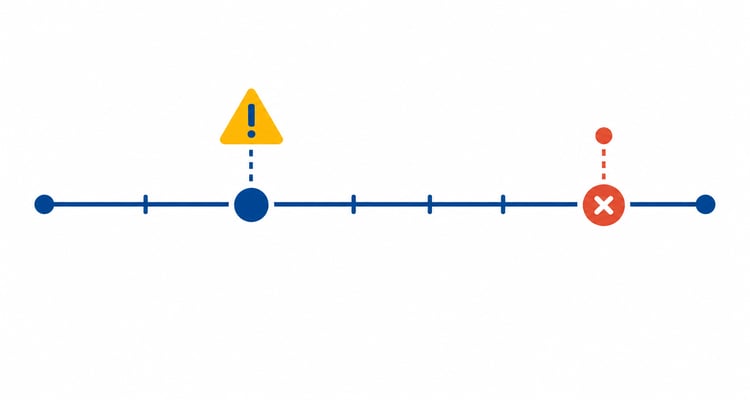
Churn rarely announces itself the moment it happens. By the time a customer cancels or quietly declines to renew, that decision was usually made months earlier and it almost always traces back to a specific moment where expectation met reality and lost (The Marketing Juice, 2026). The handoff is frequently that moment, even though the actual churn event shows up on a dashboard much later, disconnected from its real cause.
A few signals tend to show up early when a handoff has gone wrong: CSMs repeatedly asking sales clarifying questions after the account has already transitioned, customers re-explaining goals they thought they'd already communicated, expansion conversations stalling because no one has a clear read on what "success" means to that specific buyer, and a slower than expected time to first value. A high volume of CS to sales follow-up questions after handoff is, on its own, a fairly reliable signal that the documentation was incomplete (AskElephant, 2026).
8. What a Good Handoff Actually Looks Like
The best-performing organizations don't treat this as a simple email with a PDF attached. They treat it as a coordinated transition with clear ownership, shared context, and momentum carried forward rather than reset to zero (Prezentor, 2026). A few practices show up consistently in teams that get this right:
Indefinite co-management between sales and CS isn't the goal that creates its own confusion about who actually owns the relationship. The goal is a clean, well-documented transition with just enough overlap to preserve continuity (Sybill, 2026).
 If you're ready to see ClientPoint in action, claiming a free demo with one of our experts only takes a minute.
9. Measuring the Handoff Like It Matters

If a handoff is revenue-critical, it should be measured like one. Leading teams track metrics like time-to-first-value, onboarding completion rate within a target timeframe, 30/60/90-day customer satisfaction, and first-year churn segmented specifically by handoff quality (Sybill, 2026). Some go further, tracking a formal "handoff document completeness score" the percentage of required context fields actually populated before CS takes over alongside 90-day churn rate split by that same score (AskElephant, 2026).
The pattern worth watching for isn't a single bad handoff, it's a trend. When CSMs consistently report incomplete handoff briefs, when customers routinely complain about repeating themselves, or when expansion conversations aren't happening on the schedule they should be, that's a process problem, not a one-off account issue (Sybill, 2026).
|
Bottom Line A fumbled lead handoff costs you a potential deal. A fumbled customer handoff costs you actual, already won revenue and it does it quietly, months before the churn shows up on a report. The handoff isn't the end of the sales process or the start of customer success. It's the seam between them, and seams are exactly where things tend to tear. |
10. How ClientPoint Closes the Gap
If you're ready to see it in action, claim a free demo here and we'll walk you through it.
This is where the two problems, the RFP intelligence gap and the handoff breakdown, converge. And it is exactly where ClientPoint was built to help.
Every RFP response your team submits contains critical intelligence about the buyer. Their specific challenges, their decision criteria, their stakeholder landscape, their definition of success. That intelligence should not live and die inside a proposal document. It should travel with the client through every stage of the relationship, from the first proposal to onboarding, renewal, and beyond.
ClientPoint makes that possible.
With ClientPoint, your team can:
Build and send personalized, professional proposals in minutes not hours, using MEG AI Pro to generate tailored content based on each buyer's specific context, so your RFP response reflects genuine understanding of their situation from the very first touchpoint.
Capture and share deal intelligence seamlessly. Every proposal, document, and interaction lives in one centralized, shareable workspace that travels with the client from sales through customer success. No reconstruction. No telephone game.
Know exactly when a prospect engages with your proposal. Real time engagement analytics show you who opened your proposal, which sections they spent the most time on, and when to follow up, so your team follows up with context, not guesswork.
Close faster with built in eSignature. ClientPoint Sign routes contracts to the right stakeholders automatically, removing the final friction point between a strong proposal and a signed agreement.
Turn meetings into assets. ClientPoint Notetaker transcribes every sales conversation in real time, generating structured summaries and action items that feed directly into the handoff, ensuring nothing that was said during the sales cycle gets lost when the team changes hands.
Teams using proposal software report 22% higher win rates and recoup their investment within the first year. But the real compounding advantage is not just winning more proposals. It is what happens after the win. When the intelligence from every RFP response is captured, organized, and transferred seamlessly to the teams responsible for delivery and retention, the handoff stops being where deals go to die and starts being where client relationships actually begin.
A fumbled lead handoff costs you a potential deal. A fumbled customer handoff costs you actual, already won revenue, quietly, months before the churn shows up on a report.
The handoff is not the end of the sales process or the start of customer success. It is the seam between them. And seams are exactly where things tend to tear, unless you have the right system holding them together.
Ready to see how ClientPoint can help your team win more RFPs, close faster, and carry deal intelligence all the way through to retention?
👉 Schedule a personalized demo today and discover what a connected proposal and client experience actually looks like.
This is not just the future of digital sales. It is the new standard.
👉 Explore more of the solution center and discover how to reduce chaos, boost efficiency, and build trust at every touchpoint.