


Your pipeline says $2M is closing this quarter. Your gut says something's off. The gap between those two numbers is where revenue actually goes to die.
|
IN THIS ARTICLE 1. The forecast that isn't a forecast 2. Why your CRM is lying to you (politely) 4. Buying groups got bigger. Reps didn't get more eyes |
A rep tells their manager a deal is "closing this month." Two weeks later, it's not. Nobody lied. The champion went quiet, a new stakeholder joined late, and the CRM stage never moved because nobody updated it. Multiply that across forty open deals and you don't have a pipeline anymore. You have a spreadsheet of hope.
This is the quiet failure mode in most sales organizations. Not a lack of effort, not a bad product, not even bad reps. It's the absence of real-time visibility into what's actually happening inside a deal, between the moments a rep logs an update.
Let’s take a look at just some of the ways ClientPoint humanizes your digital selling environment and wins you and your team more deals. If you'd like to learn more about how ClientPoint can help you communicate to your clients and team, click here to book a demo with one of our experts.

Every sales leader has sat in a forecast call and watched a "committed" number evaporate in the last week of the quarter. That's not bad luck. It's a symptom of forecasting on data nobody actually trusts.
| 18.7% | of sales organizations achieve forecast accuracy of 75% or higher, according to Korn Ferry research - meaning more than 4 in 5 teams are routinely missing their own numbers. |
| 69.9% | of sales organizations still rely on CRM reporting as their primary forecasting method, despite lacking confidence in that same data, per the same Korn Ferry study. |
Source: Korn Ferry research, via GetAccept
That gap using data you don't trust because it's the only data you have is the core problem. A forecast built on stage labels a rep updated three weeks ago isn't a prediction. It's a guess wearing a spreadsheet.
The downstream cost of this rarely shows up where people expect it to. It's not just the deal that slips, it's every decision made upstream of that deal that assumed the number was real. Hiring plans get built around a forecast. Marketing spend gets allocated against a pipeline that "looks healthy." Leadership sets board expectations off a number that was never actually load-bearing. When the real outcome lands 20 or 30 points below what was reported, the damage isn't contained to one rep's quota, it ripples into budget, headcount, and credibility with the people the sales org answers to.
And the frustrating part is that most leaders already sense this. Ask any VP of Sales privately whether they trust their own forecast, and the honest answer is usually a qualified "sort of." That hedge is the tell. A forecast leaders don't fully trust isn't a planning tool, it's a formality everyone participates in because there isn't yet a better source of truth to replace it with.
 If you'd like to learn more about ClientPoint's documentation automation, or content & project management, don't hesitate to book a free demo with one of our experts.
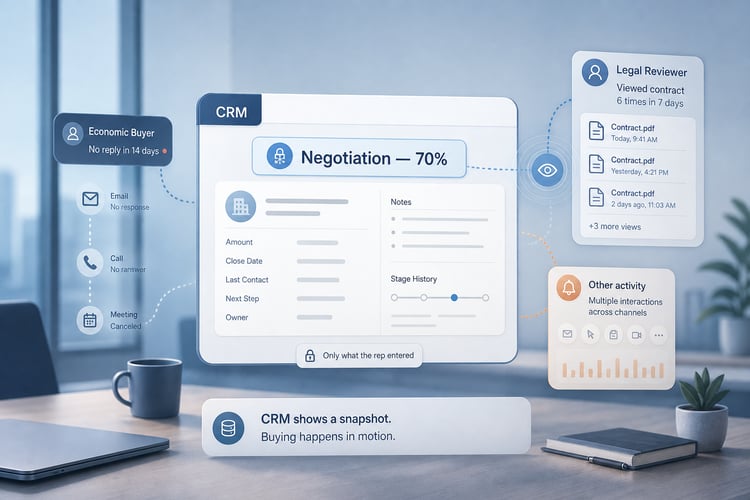
Your CRM isn't malicious. It's just incomplete. It only knows what a human remembered to type in. It doesn't know that the legal reviewer opened the contract four times this week, or that the economic buyer hasn't looked at anything you've sent in eleven days. It just shows "Negotiation - 70%," frozen in time, because that's the last thing a rep clicked.
A pipeline stage is a rep's opinion. Buyer engagement is a fact.
Gartner has pointed to poor pipeline visibility as a top reason for missed forecasts not poor selling, poor visibility. Meanwhile, structured pipeline management practices have been shown to improve forecast accuracy by up to 20%, and data-driven pipeline analysis can lift accuracy by 30–40% over gut-feel stage tracking. The fix isn't a better spreadsheet. It's replacing stale, self-reported status with live buyer behavior.
3. The Silent Stall
 If you'd like to learn more about how ClientPoint can improve your meeting setup, click here to claim a free demo with one of our experts.
Deals rarely die with a bang. They die with silence. A champion stops replying. A slide deck sits open for ninety seconds and is never opened again. A rep keeps the deal "on track" in the CRM because nothing has explicitly gone wrong it's just gone quiet.
By the time a rep says "radio silence" out loud in a pipeline review, the deal has usually already been cooling for two weeks, per GetAccept's reporting on pipeline visibility. Visibility isn't about catching the moment a deal dies. It's about catching the moment it starts going quiet, while there's still time to do something about it.
Part of what makes the silent stall so dangerous is that it doesn't look like a red flag from the rep's side of the desk. A buyer who's gone quiet often isn't rejecting the deal they're stuck. Maybe procurement asked a question nobody on the vendor side answered. Maybe a competing internal priority bumped the project down the list for a few weeks. From the outside, that looks identical to a deal that's cooling for good, which is exactly why reps default to "still on track" instead of raising a flag they can't actually justify with evidence.
This is also where forecast confidence quietly erodes deal by deal. A single stalled deal is a rounding error. Ten stalled deals sitting unflagged across a pipeline is a forecast built on sand, and nobody notices until the quarter closes and the math doesn't work. The earlier a stall is visible ideally within days, not weeks the more options a rep and their manager still have: a re-engagement email, a call to a different stakeholder, an internal escalation. Wait until it surfaces in a pipeline review, and most of those options have already closed.
4. Buying Groups Got Bigger. Reps Didn't Get More Eyes.

The modern B2B deal isn't a conversation between a rep and a single champion anymore. Gartner reports that buying groups now typically include 5 to 16 people spanning four or more functions, as cited in GetAccept's 2026 pipeline visibility guide. Legal, finance, IT security, and end users all weigh in often without ever speaking to the rep directly.
Most reps are still single-threaded: they know their champion, and they're flying blind on everyone else in the room. If a CFO you've never met spends twenty minutes on your pricing page, that's a buying signal worth acting on immediately. Without visibility into who's actually engaging, that signal never reaches the rep at all.
This mismatch compounds as deal size grows. Larger deals almost always mean larger buying committees, which means more silent stakeholders forming opinions the rep never gets to influence. A security reviewer who quietly decides your integration story is too thin can kill a deal weeks before procurement ever raises it out loud and a single-threaded rep has no way of knowing that happened until it's reflected in a "we're going another direction" email.
The practical fix isn't necessarily getting every rep into every stakeholder conversation that doesn't scale, and most buying committees won't allow it anyway. It's making the stakeholders who are engaging visible even when they never pick up the phone. Knowing that three new logins from the buyer's domain showed up on a proposal this week, even without a name attached to two of them, is still more than most reps get today. It's the difference between negotiating against a single known variable and negotiating against a committee you can't see.
 Real visibility means knowing, without asking a rep, which stakeholders have opened a proposal, how long they spent on which section, and who's newly involved in a deal that used to be a two-person conversation. This is exactly what a digital sales room is built to surface a shared, trackable space where every document lives, and every interaction with it is visible the moment it happens.
| With ClientPoint, a digital sales room gives reps and managers a live view of who's engaging with a deal, which stakeholders have shown up, and where a proposal is actually being read not just where it was sent. That's the difference between a status update and a signal. |
When forecasts are built on that kind of engagement data instead of a rep's memory, they stop being a prediction of what someone hopes will happen and start being a reflection of what's actually happening.
6. Making visibility a habit, not a tool
Tools alone don't fix this. Cadence does. Teams that run structured, weekly pipeline reviews grounded in real engagement data rather than status recitals consistently outperform teams that review monthly.
| 76% | quota attainment for teams coached on their pipeline weekly, according to the State of Sales Coaching research. |
| 56% | quota attainment for teams coached only monthly the same research, the same reps, just a slower cadence of visibility and coaching. |
Source: MySalesCoach 2026 Sales Coaching Study, via Weflow
That 20-point gap isn't about talent. It's about how often someone actually looks at what's really happening in a deal and intervenes before it's too late.
| ✔️ | Audit how many "committed" deals in your current pipeline haven't had a stage update in over 14 days. |
| ✔️ | Ask reps which stakeholders in their top five deals they've never actually spoken to |
| ✔️ | Move pipeline reviews from monthly to weekly for at least one quarter and track the difference. |
| ✔️ | Give reps a way to see buyer engagement directly, instead of relying on the buyer to volunteer it. |
👉 Explore more of the solution center and discover how to reduce chaos, boost efficiency, and build trust at every touchpoint.